Unintentional Gaslighting: When Fear Rewrites Reality

Rethinking What Gaslighting Looks Like
When people think of gaslighting, they think of a guy twirling his mustache in the corner, hatching a plot to make his girlfriend feel insane. Sometimes, gaslighting is intentional and is a deliberate attempt to manipulate and control a partner. However, not all gaslighting is deliberate. In some relationships, unintentional gaslighting can occur when people defensively rewrite reality to protect themselves emotionally.
What Is Gaslighting
Gaslighting is defined as “a tactic of psychological manipulation in which an individual attempts to control their intimate partner by convincing them that their thoughts, beliefs, and memories are groundless, or ‘crazy’.” It requires a consistent pattern of one person denying, distorting, or reframing reality, specifically in a way that causes the other person to doubt the validity of their own thinking and memory (Darke et al., 2025). In many cases, intentional gaslighting is used as a form of emotional abuse, gradually leading the recipient to experience confusion and self-doubt about their perceptions and feelings.
Core features:
- Repeated denial of observable events
- Shifting blame onto the recipient
- Undermining confidence in one’s emotional responses
- A growing power imbalance
But Can Gaslighting Be Unintentional?
When people hear the term gaslighting, they usually imagine deliberate emotional manipulation. Through my work with couples, I’ve seen that gaslighting doesn’t always come from deliberate manipulation, which leads to an important question: can gaslighting be unintentional?
In examining real-life relationships, it’s clear that the answer can be yes. Sometimes people unintentionally gaslight their partners, not out of a desire for control, but as a reaction to protect themselves from uncomfortable emotions.
What Is Unintentional Gaslighting?
To clarify, unintentional gaslighting occurs when someone denies, distorts, or reframes events without conscious intent to manipulate their partner. Instead of calculated deception, this behavior is often triggered by defensiveness, fear, or insecurity.
In these instances, the person may truly believe their version of events. Their mind reshapes reality to reduce guilt, shame, or fear of rejection. As a result, some researchers have referred to this as unconscious gaslighting.
This raises a question many people ask: do gaslighters know they are gaslighting? In some cases, they do not. Even though the behavior may not be intentional, it can still function as a harmful form of gaslighting and lead to confusion and self-doubt for the other partner.
Lying to You or Lying to Themselves?
If gaslighting is defined as a pattern of behavior that undermines another person’s sense of reality, what happens when the distortion comes from the gaslighter’s own skewed perception of events? It isn’t necessarily an effort to manipulate and control their partner, but rather an unintentional consequence of them rewriting reality for their own emotional protection. *
I see this dynamic frequently in relationships. To illustrate how unintentional gaslighting can unfold, I want to share a recent case from my practice involving a couple I’ll call Oliver and Ava.
Case Example: Oliver and Ava
Ava recently started working with me as her dating coach to try to save her relationship, which she desperately wanted to fix, even though she knew that she couldn’t continue as it is. She had been with her partner, Oliver, for two years. For the most part, their relationship was very healthy, although Oliver had an avoidant attachment style. They loved and respected each other, rarely got into disagreements. However, recently, Ava had started noticing that Oliver would frequently respond defensively when she was bringing up her feelings. She also noticed that when they were having emotional conversations, Oliver tended to say things that weren’t true. Ava cares deeply about honesty, and having someone lie to her is the worst relationship action for her. She didn’t know how to rectify Oliver being such a good person and typically trustworthy, with consistently saying things that were just a little bit untrue. Not to mention that Oliver’s job was relocating him to another state in six months, and they would be long-distance.
When the Behavior Changed
In the most recent example, which prompted her to seek coaching, Oliver had started suddenly acting distant: ignoring phone calls, not calling or reaching out, sending short text responses, and taking a long time to respond to Ava’s texts. While they were both busy and didn’t always keep in constant contact, Ava could tell that something was wrong. But when she reached out, expressing that something seemed wrong, Oliver would say that he was just busy, and nothing was up. After about a week, Ava said that it was important that he call her urgently. He said he was busy at work but could call her later in the day. They scheduled a time for the afternoon, but when that time came, he said he only had 20 minutes before a meeting. At the end of the call, he said that the meeting would only be about 20 minutes, and he would call her as soon as it was over. After an hour had passed, Ava reached out again and asked if he was going to call her. He said something came up and he needed another hour. They did eventually end up having a conversation, but Ava was frustrated by the difficulty in getting in contact with him. Ava said that she knew that was only happening because he was avoidant and couldn’t emotionally handle difficult conversations, but she didn’t know how she could continue being in a relationship where she couldn’t trust that he would be able to come to the table when problems arose.
Reality Disputed
During their call, Oliver maintained his insistence that nothing was wrong and that he didn’t know what she was talking about when she said he was communicating less. He claimed that he had called Ava multiple times that week and that she was the busy one. He had called Ava only once that week, and she didn’t pick up. When Oliver insisted that he called her a lot, Ava said that she looked at the call logs and he didn’t. She asked him to go into his call logs and see if maybe his calls just weren’t going through. Oliver responded that there is no need to go into this detail, and that isn’t really the point.
Also, during the conversation, Oliver said that at the beginning of the week, he found out that instead of the six months they were supposed to have until he moved, he would be moving next month. Despite him learning this news at the exact time he started being distant, he insisted that this hadn’t changed his behavior at all, and Ava was making an issue where there wasn’t one. He also said that, really, it was Ava who wasn’t available and that they were both causing the distance.
Ava’s Dilemma
When Ava told me this story, it was clear that she was really torn. “I love him so much, but we can’t fix problems if he won’t admit that they are there. I think he thinks that he is convincing me that my perception is wrong, but really, I just stop fighting it because there is no way to fix it if we can’t agree on the facts.”
In learning more about their relationship, Oliver’s rewriting the facts and acting defensively when Ava shared her feelings was a common theme. Ava said that in the beginning, when this happened, she did doubt herself, that maybe she was remembering situations wrong. But as time went on, she noticed the pattern and that Oliver’s account of situations often had glaring inaccuracies. Oliver was generally someone with a lot of integrity and honesty. The problem was that Oliver didn’t seem to know that what he was saying wasn’t true.
Attachment, Fear, and Self-Protection
Ava also noticed that he tended to respond in this way in situations of uncertainty, where Ava might reject him. Those situations also led him to act like he cared less, which in turn meant he would contradict himself. He would say things like Ava was the love of his life, and he wanted to spend every day with her, but then if something happened that made him worried Ava would leave, he would contradict himself. Ava had never expressed that she would consider leaving, but in some disagreements, he would ask if Ava wanted to leave, saying that it would be ok because their relationship wasn’t that serious. It was very clear that he did this to push her away and convince himself it didn’t matter and wouldn’t really hurt if she didn’t want him anymore.
She completely loved him and didn’t approach situations by accusing him. She approached situations like they were on a team and working on the relationship difficulty together. A lot of the time, Oliver would act the same. But sometimes, when he felt guilty or insecure, he would rewrite the past like he didn’t have a part to play in the difficulty or that it was Ava’s fault. This made Ava sad because she didn’t care whose fault it was or if she was “right”. She just wanted to be with Oliver and be able to work through problems together. When she came to me, she didn’t know if she could stay with Oliver if that was how he handled conflict. She knew that he loved her, but it hurt when he tried to act like he didn’t care or would avoid addressing important problems in their relationship.
Unintentional Gaslighting in Action
Ava and Oliver’s relationship is a classic example of unintentional gaslighting. Oliver contradicts himself, rewrites the facts, and makes Ava doubt her interpretation of events. However, Oliver wasn’t lying to Ava. He was lying to himself.
Despite his generally high emotional intelligence, when his attachment system was activated, he lost his usual sense of objectivity. Your attachment system is integrally tied to your fight, flight, or freeze response (Music, 2014). To Oliver, losing Ava or not being enough is a real threat. The same way that a presentation at work makes us feel the same type of anxiety that would come from running into a lion, Oliver’s reaction is based on a biological fear response. Avoidant attachment operates on the base assumption, “I am not good enough.” So, if Oliver feels that Ava may be starting to see that, his system panics and tries to protect him from being hurt. He pushes her away. He convinces himself (and tries to convince her) that he didn’t do anything wrong. He focuses on how it is Ava’s fault, not his. This isn’t because he doesn’t love Ava, quite the opposite. Losing Ava is scary, and his brain is subconsciously trying to protect him from getting hurt.
When Coping Mechanisms Backfire
The problem is that in the process of trying to protect him from his emotions, he is creating an issue in the relationship that they may not be able to rectify. As with so many things in psychology, the coping mechanisms our brain uses often lead to us experiencing the exact thing we were trying to avoid.
Signs of Unintentional Gaslighting in Relationships
In my work with couples, I often see people struggling to recognize when gaslighting is happening because it doesn’t always look like deliberate manipulation. Many people assume gaslighting must involve someone trying to gain power or control in a relationship. However, in some cases, the behavior happens defensively, without full awareness.
This is why people sometimes ask whether unconscious gaslighting is abuse. Even when the intent is not malicious, certain gaslighting behaviors can still have a significant impact on trust, communication, and a partner’s self-esteem.
Some common signs of unintentional gaslighting include:
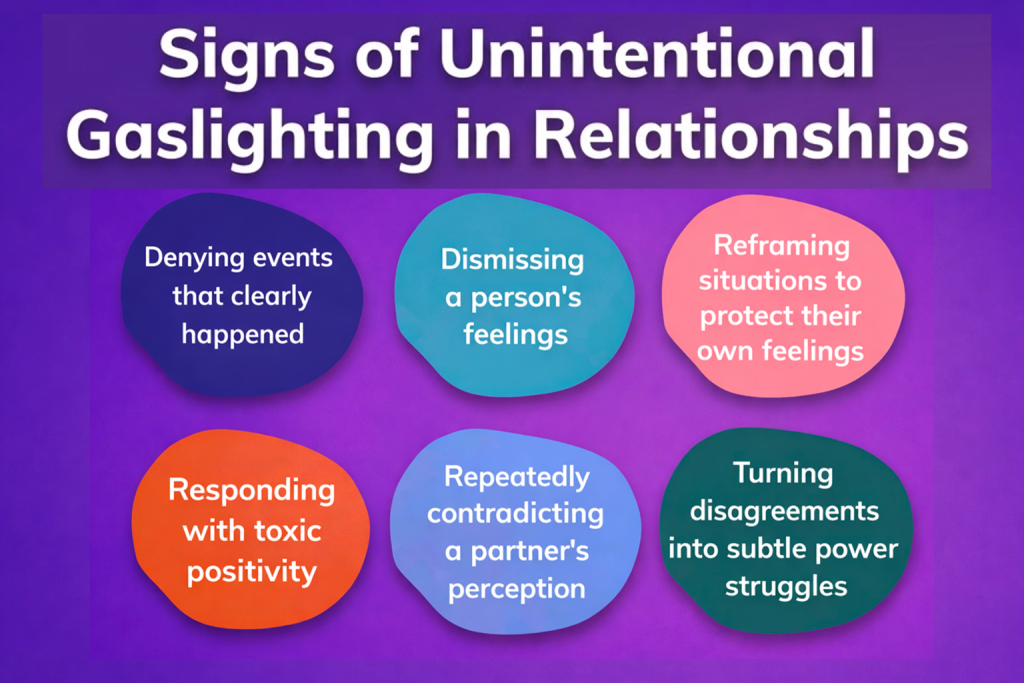
- Denying events that clearly happened. The person may insist that conversations occurred differently or that certain events never happened, even when there is evidence. This can make their partner question their memory.
- Dismissing a person’s feelings. When someone expresses hurt or concern, the response may focus on explaining why those emotions are wrong or exaggerated rather than acknowledging the person’s feelings.
- Reframing situations to protect their own feelings. Instead of taking responsibility during conflict, the person may reinterpret the situation in a way that protects their own feelings or reduces guilt.
- Responding with toxic positivity. Statements like “you’re overthinking,” “just stay positive,” or “it’s not a big deal” may seem supportive, but toxic positivity can dismiss legitimate emotional experiences.
- Repeatedly contradicting a partner’s perception. Over time, these contradictions can cause someone to question their own interpretation of events and gradually erode their self-esteem.
- Turning disagreements into subtle power struggles. Even without intending to gain power, consistently dismissing a partner’s reality can create an imbalance where one person’s perspective dominates the conversation.
Over time, these patterns can make a partner feel confused, unheard, or uncertain about their own perception of reality, even when the behavior was not meant to cause harm.
Additional Examples of Unintentional Gaslighting I Often See in My Work
The situation between Oliver and Ava is not unusual. In my work with couples, I frequently see similar patterns where people unintentionally distort events during conflict. These unintentional gaslighting examples often happen in otherwise caring relationships, especially when someone feels defensive or afraid of losing connection in a romantic relationship. In most cases, the person is not trying to gain control or manipulate their partner. However, the behavior can still feel hurtful and gradually affect the other person’s self-worth.
Some examples I often observe include:
- Denying a conversation that clearly happened. A partner insists they never said something that the other person remembers clearly. Even if the denial is unintentional, it can make the other partner question their memory and confidence.
- Minimizing emotional reactions. When someone expresses that they feel hurt, their partner may respond with phrases like “you’re overreacting” or “it wasn’t a big deal,” which can invalidate the other person’s experience.
- Reframing a conflict to avoid responsibility. Instead of acknowledging their role in a disagreement, a person may reinterpret events in a way that protects their image or avoids discomfort.
- Shifting blame during disagreements. Statements like “I only reacted that way because you pushed me” can unintentionally place responsibility on the other partner and resemble attempts at maintaining control of the situation.
- Contradicting how the other person remembers events. Repeatedly correcting or dismissing a partner’s version of what happened can slowly undermine their self-worth and confidence in their own perception.
Over time, even subtle patterns like these can create confusion and tension within a romantic relationship, especially if they happen repeatedly.
Why Gaslighting, Intentional or Not, Is Harmful
I don’t yet know how Oliver and Ava’s relationship will unfold after our consultations or whether they will choose to work on these dynamics. What I do know is that gaslighting, intentional or not, is destructive to a relationship. Over time, victims of gaslighting are more likely to develop or exacerbate mental health disorders. Gaslighting also makes victims lose trust in themselves and doubt their own sense of reality, as well as their identity (Akdeniz & Cıhan, 2024). Engaging in unintentional gaslighting doesn’t make someone a bad person, but it does prevent them from having healthy relationships.
How to Stop Unintentional Gaslighting
Once someone becomes aware of these patterns, change becomes possible. These are some of the strategies I recommend to help stop unintentional gaslighting in relationships.
- Pause before correcting your partner’s memory. If your first reaction is “that’s not what happened,” stop and ask yourself whether you might be reacting defensively. This small pause creates space for a conscious effort to understand the situation rather than immediately dismissing it.
- Acknowledge your partner’s feelings before explaining your perspective. Even if you remember events differently, validate the other person’s emotions first. Saying something like “I see why that would make you upset” prevents you from unintentionally dismissing a partner’s experience.
- Check the facts instead of relying only on memory. If there is disagreement about what happened, look at messages, notes, or other evidence together. This helps prevent arguments from turning into debates about reality.
- Build stronger self-awareness during conflict. Pay attention to moments when you feel embarrassed, guilty, or criticized. Those emotions often trigger defensive reactions that lead people to reinterpret events to protect themselves.
- Take responsibility when you realize you were wrong. If you discover that your partner’s version of events was accurate, acknowledge it directly. Admitting mistakes protects the relationship and helps rebuild trust.
- Work on underlying emotional triggers. In many cases, these reactions are connected to fear of rejection or threats to self-awareness and self-worth. Tools from clinical psychology, such as learning emotional regulation or communication skills, can help people tolerate uncomfortable emotions without distorting reality.
- Seek outside support if the pattern continues. If these dynamics happen frequently, working with your own therapist or seeking professional help through counseling can help uncover deeper relationship patterns and prevent behaviors that may resemble psychological abuse in their impact.
Protecting Yourself and Moving Forward
If you believe that you are experiencing gaslighting, it is important that you set boundaries and understand what you will and will not tolerate. This may mean ending the relationship if they are not able to or willing to work on their behavior. Many people assume that relationship problems only begin once a relationship is established, but in my work as a dating coach, I often see how modern dating environments can shape unhealthy dynamics long before that. I explore this further in my case study on swipe fatigue and why online dating often makes connections harder.
It is often difficult for someone to change their manipulative behavior, especially if it is unconscious. A therapist or dating coach can help you understand if gaslighting is occurring and how to change the relationship pattern. Overall, focus on self-compassion and being conscious of when your interpretation of events conflicts with your partner. It may even be helpful to keep track of when this happens, so that you can reexamine the facts more objectively. The most important relationship you have is your relationship with yourself. If you feel that your partner is making you doubt your identity or reality, confront the facts, lean on the people in your life for support, and be willing to put your well-being first.
A Note from the Author:
* There is disagreement in academia about how intent factors into the official definition of gaslighting (Darke et al., 2025), but I am focusing on gaslighting as an action separate of intent.
References
- Akdeniz, B., & Cıhan, H. (2024).
Gaslighting and interpersonal relationships: A systematic review. Psikiyatride Güncel Yaklaşımlar, 16(1), 146–158. - Music, G. (2014).
Attachment, our brains, nervous systems and hormones. In J. Holmes & S. Farnfield (Eds.), The Routledge handbook of attachment: Theory (pp. 127–147). Routledge. - Darke, L., Paterson, H., & van Golde, C. (2025).
Illuminating gaslighting: A comprehensive interdisciplinary review of gaslighting literature. Journal of Family Violence, 1–17. - Sweet, P. L. (2019). The sociology of gaslighting. American Sociological Review.